
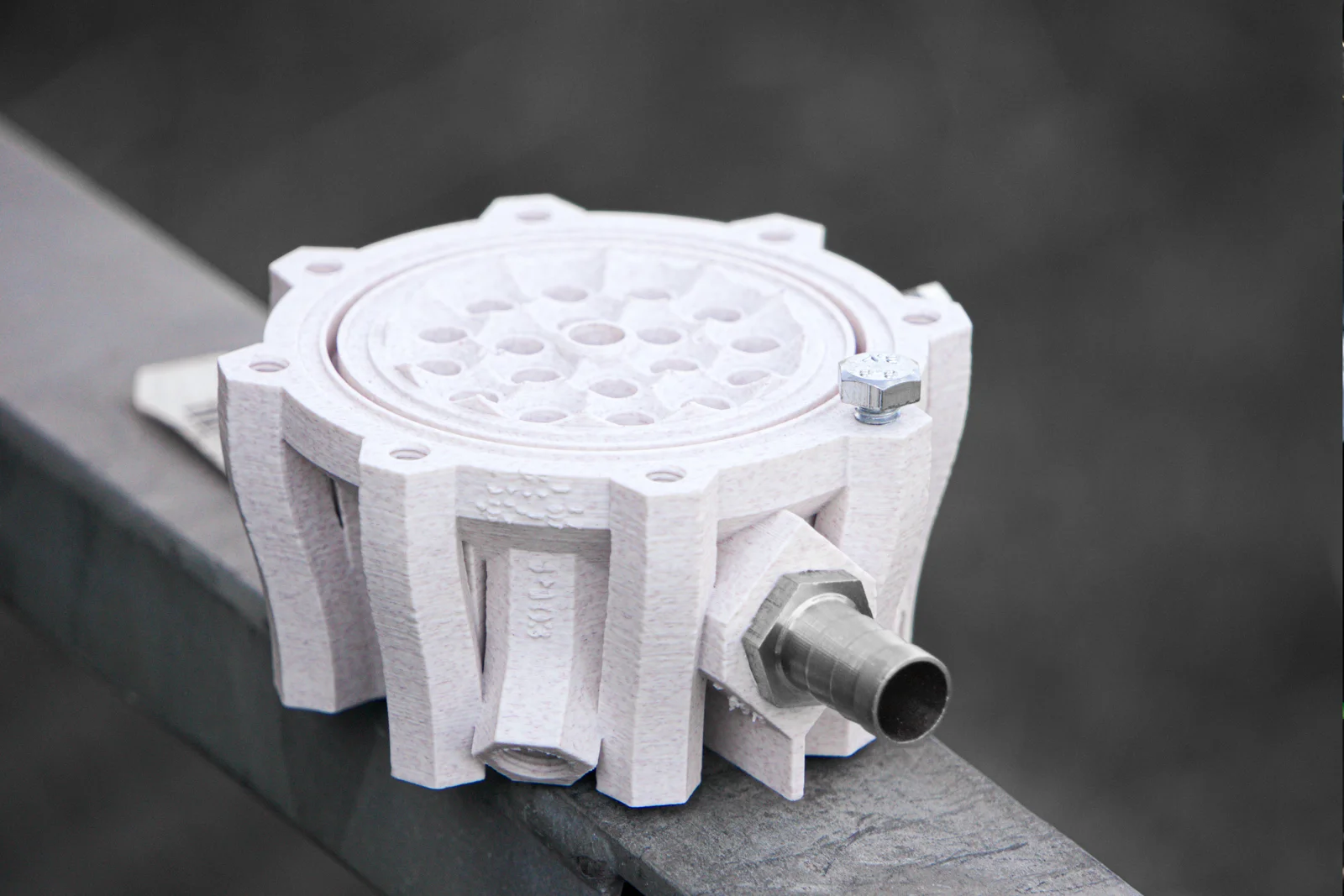
In the pursuit of orbital efficiency, every gram matters. At Elara Aerospace, the bridge between complex physics and manufacturable hardware is built within the Autodesk ecosystem. By leveraging Fusion 360 and Netfabb, Elara’s engineering team is pushing the boundaries of what rocket components can look like and what they can achieve.
The core of this digital revolution is generative design. Instead of manually drafting components, Elara’s engineers define the load cases, material constraints, and spatial boundaries. Autodesk’s AI-driven algorithms then explore thousands of permutations, resulting in organic, "bone-like" structural geometries that offer maximum strength with minimum mass.
"Generative design isn't just about making things look futuristic; it's about structural honesty. It places material only where the physics demands it, allowing us to build lighter, faster, and more efficient vehicles."
From the high-pressure cooling manifolds of the 28 kN engine to the structural brackets of the Hopper vehicle, the "Digital Twin" approach ensures that every part is optimized before the first laser hits the powder bed. This tight integration between design and additive manufacturing allows Elara to iterate at a pace traditionally reserved for software development.
By partnering with Autodesk, Elara Aerospace is not just building rockets; it is building a modern, cloud-connected design workflow. A highlight of this collaboration is Elara’s presence at Autodesk University, where the program’s innovative use of generative design and additive manufacturing serves as a case study for the future of aerospace engineering.
The "Digital Twin" approach allows the team to empower the next generation of European aerospace engineers, solving the industry’s toughest challenges through collaborative, data-driven design.