Hopper V2’s propellant tank uses a common bulkhead: a stainless-steel plate separating liquid oxygen from liquid methane. A design report prepared by Rufus Henschek, dated 25 October 2026, sets out how this plate can balance structural performance, mass, and manufacturability.
Designing for the pressure imbalance
The two compartments normally operate at the same pressure, leaving little pressure difference across the bulkhead. The demanding design case is a loss of pressure in one compartment. The bulkhead must keep the propellants separated under the resulting load, which can act from either side.
The study combines hand calculations, numerical models, and a complete-tank Ansys analysis. It also examines the position of the oxygen line opening. Moving the opening away from the centre reduces the calculated stress concentration and local deflection in the reference plate model.
A reinforced layout, refined through simulation
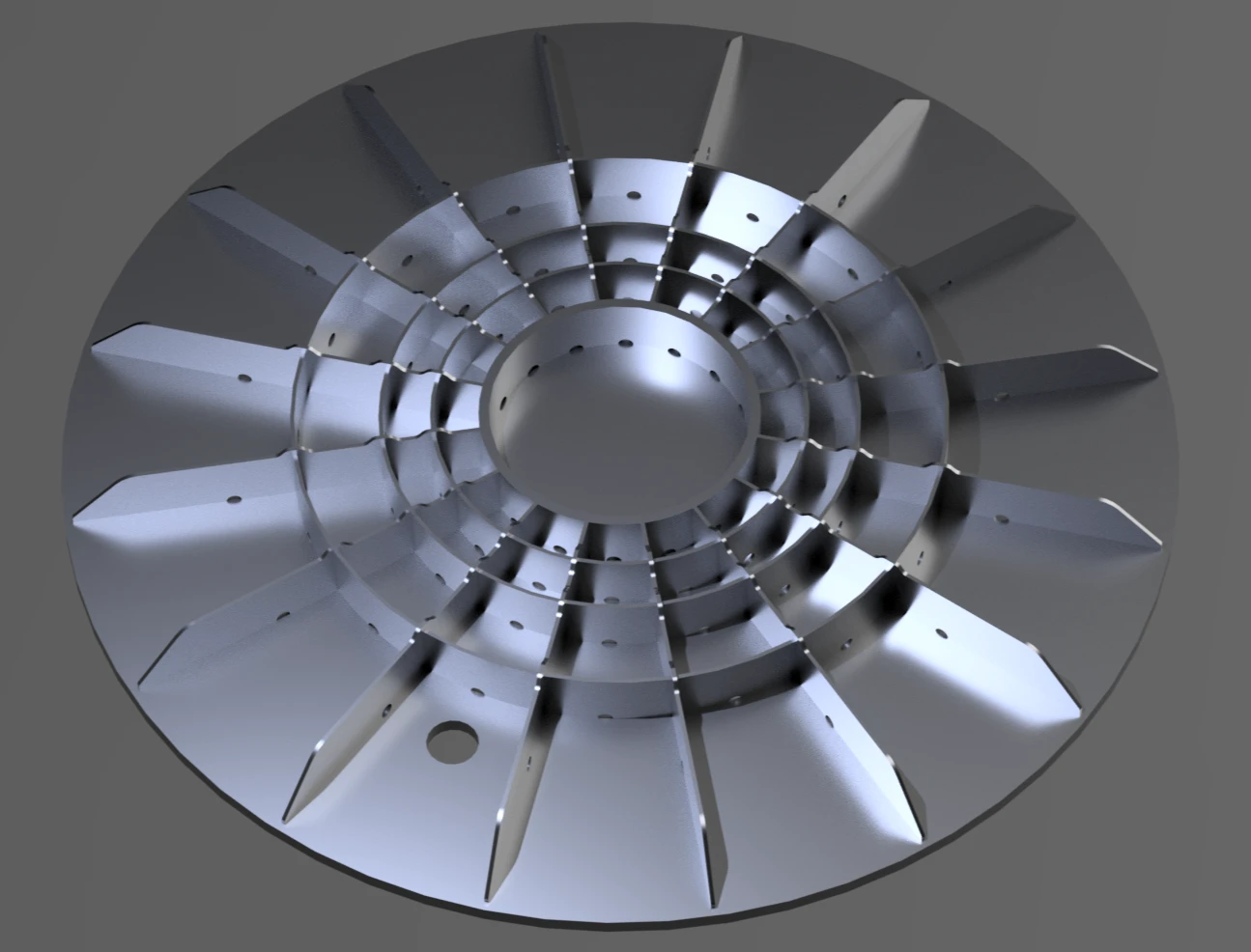
The selected layout combines an 8 mm 316L stainless-steel plate with 16 radial stringer positions, three concentric reinforcing rings, and a central hub. The reinforcing webs are mirrored on both sides of the plate. The study reports a plate mass of 15.0 kg and a stiffener mass of 6.10 kg.
The complete-tank simulation informed two refinements: increasing the hub wall thickness from 2 mm to 5 mm and chamfering the outer ends of the radial webs. These changes address local stress concentrations identified in earlier versions.
What the analysis shows
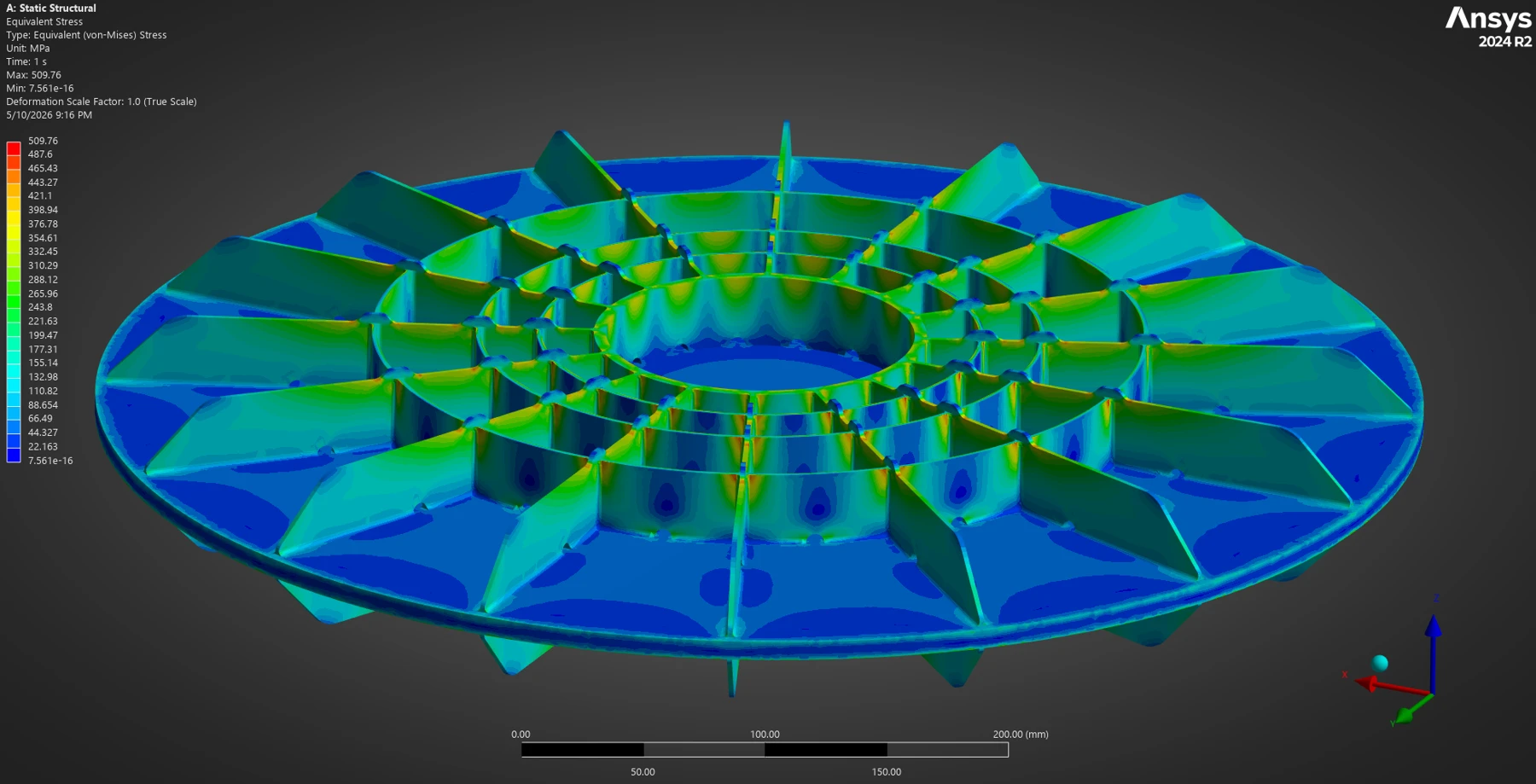
At the stated cryogenic design condition and a pressure difference of 0.7 MPa, the report predicts a maximum deflection of approximately 1.5 mm in the complete-tank model. The analytical and numerical models give roughly 1.5–1.8 mm, below the study’s 4 mm deflection limit.
The report also identifies limits that require experimental validation. Local stresses at ring fillets reach approximately 480–510 MPa, some slot weld stresses exceed the reduced weld allowance, and the material response of the actual sheet has not yet been measured. The design remains experimental, with a target technology readiness level of 4–5.
From design to manufacturing and testing
The manufacturing plan uses cut sheet-metal webs, bent rings, a rolled hub, and laser-welded joints. A temporary 3D-printed fixture is planned to help align the reinforcement grid during tack welding.
The next step described in the report is staged validation: a reduced-pressure water test at room temperature, followed by a cold liquid-nitrogen test and then testing with the actual propellants. These are planned steps; the document does not report completed physical tests. The work provides a documented design basis for fabrication and validation of the common bulkhead.
Read the design report
Hopper V2 Tank Plate — Design Document, Version 2.2 (external edition)
Prepared by Rufus Henschek · 25 October 2026 · 52 pages.